For a long time, global companies looked at India through a narrow lens:
outsourcing, cost savings, and back-office support.
That version of India still exists—but it is no longer the full story.
The India of 2026 is increasingly becoming something much bigger:
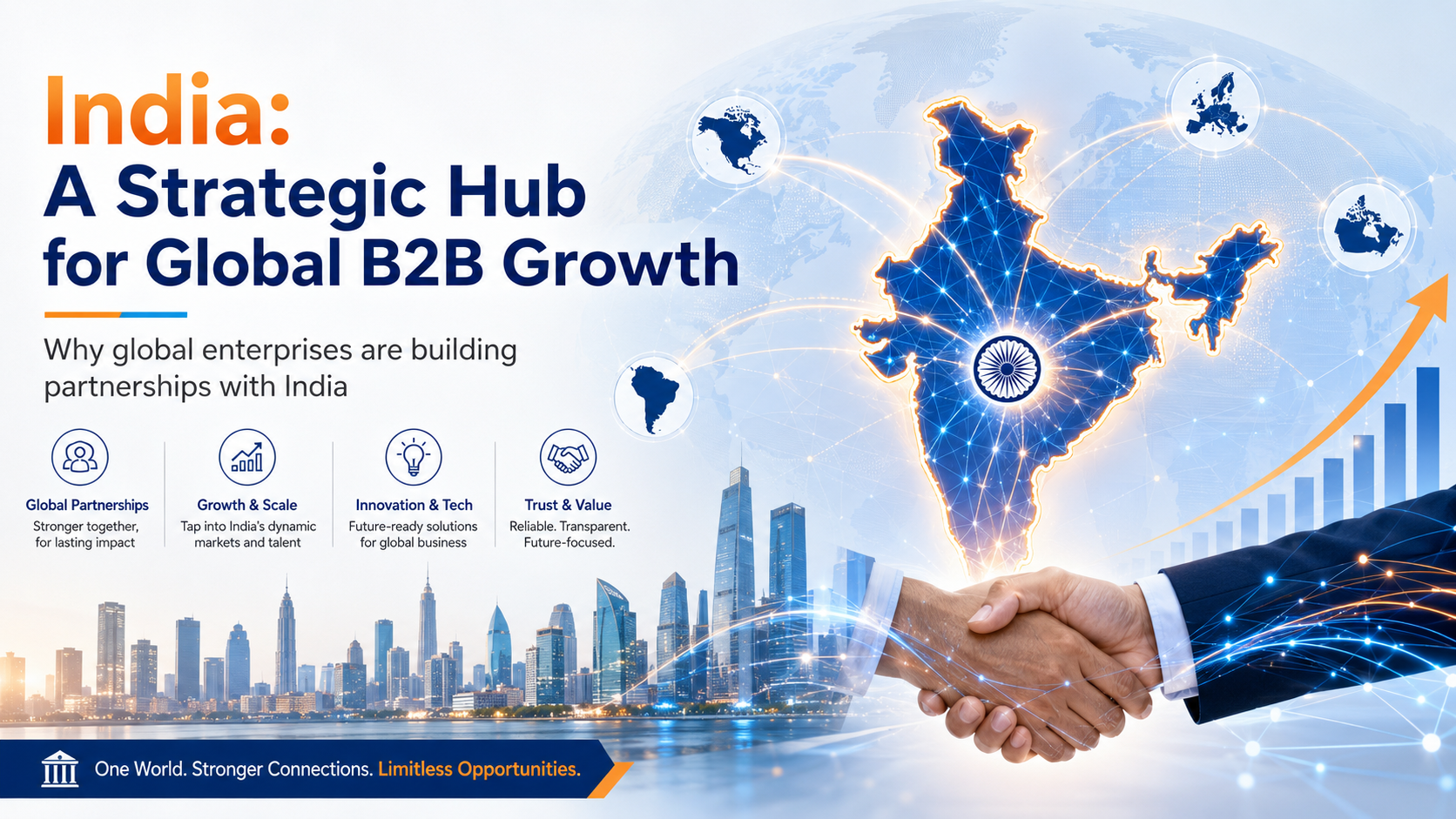
A strategic B2B platform for technology, global delivery, artificial intelligence, engineering, shared services, digital transformation, research, and market expansion.
The evidence is already visible. India remains the fastest-growing major economy, with the World Bank reporting 6.5% growth in FY2024–25. The Bank also noted that strong service exports—especially software and business services—were an important driver of that growth.
India now has roughly 1,700 Global Capability Centers, or GCCs, serving multinational companies. These centers are no longer limited to transactional work. They increasingly handle advanced functions in engineering, analytics, cybersecurity, product development, finance, AI, cloud, healthcare, and research.
At the same time, India is rapidly expanding the infrastructure needed for the next phase of global enterprise technology. In 2026, the government announced plans to expand national AI compute capacity beyond 38,000 GPUs by adding another 20,000, while major private-sector investments are also accelerating data-center and cloud infrastructure development.
So the question for enterprise leaders is changing.
It is no longer:
“What work can we move to India?”
It is:
“What can India help us build, scale, and transform?”
India Is No Longer Just an Outsourcing Destination
Outsourcing was India's opening act.
Global capability is the bigger story.
The World Bank has pointed out that more than 40% of India's exports are services and that business services are the country's single largest export industry.
That matters because it shows how deeply business services have become embedded in India's economic structure.
India today supports global companies across areas such as:
- software engineering
- AI and machine learning
- finance and accounting
- healthcare operations
- analytics
- cybersecurity
- customer operations
- cloud engineering
- product development
- supply-chain support
- business-process management
- research and development
The old outsourcing model was transactional.
A company sent work.
A vendor completed it.
The invoice was paid.
The new model is strategic.
Global companies are increasingly asking Indian teams to:
- design
- innovate
- automate
- analyze
- build
- improve
- manage
- scale
That distinction is huge.
Why India Is Attracting Enterprise Attention
1. India Gives Businesses Something Hard to Find: Capability at Scale
A company may be able to hire a great AI engineer in Boston.
It may find an excellent data scientist in Toronto.
It may find strong software engineers in Germany.
It may build a capable nearshore team in Brazil, Colombia, or Argentina.
The challenge begins when a business needs hundreds of people across multiple skill sets.
Imagine needing:
- software engineers
- cloud architects
- QA engineers
- AI specialists
- finance analysts
- customer support teams
- healthcare operations specialists
- project managers
- cybersecurity professionals
- data engineers
all within the same global delivery structure.
That is where India's scale becomes a competitive advantage.
The country has spent decades building a professional-services ecosystem capable of supporting large multinational operations.
2. The Rise of GCCs Changes the B2B Equation
One of the clearest signs of India's transformation is the growth of Global Capability Centers.
GCCs are offshore operations established by multinational corporations to perform strategic business functions.
India now hosts around 1,700 GCCs.
But today's GCC is very different from yesterday's offshore service center.
Modern GCCs increasingly handle:
- AI engineering
- advanced analytics
- cybersecurity
- product development
- financial planning
- risk management
- R&D
- digital transformation
- global operations
This tells enterprise leaders something important.
Major global corporations are not merely buying services from India.
They are embedding India directly into their operating model.
That is a much stronger signal than any marketing campaign.
3. India's AI Infrastructure Is Becoming a Serious Strategic Asset
AI will likely become one of the biggest drivers of enterprise productivity over the next decade.
India clearly understands this.
In February 2026, the Indian government announced plans to add 20,000 GPUs to an existing national AI infrastructure base of approximately 38,000 GPUs.
India is also seeing enormous proposed investment in data centers and AI infrastructure. For example, a June 2026 government announcement highlighted a proposed investment of roughly $30 billion by AirTrunk to develop 5 GW of data-center capacity in India.
India's digital ecosystem now spans:
- AI
- cloud computing
- semiconductor initiatives
- data centers
- digital public infrastructure
- enterprise software
- fintech
- health technology
For B2B partnerships, that creates fertile ground.
A company entering India is no longer entering a low-cost labor market.
It is entering a rapidly expanding digital economy.
4. India vs. USA: The Smart Model Is Not Either/Or
The United States remains the world's most important market for many enterprise technology and B2B companies.
It provides:
- capital
- customers
- innovation
- research institutions
- highly skilled talent
- sophisticated enterprise demand
But scaling in the United States is expensive.
According to the U.S. Bureau of Labor Statistics, the mean annual wage for software developers reached about $148,100 in May 2025.
That does not mean companies should replace American workers with Indian teams.
That thinking is too simplistic.
The smarter model is:
USA + India.
Keep:
- leadership
- sales
- customer relationships
- product strategy
- regulatory accountability
close to the customer.
Use India for:
- engineering
- analytics
- AI
- development
- operations
- testing
- support
- global delivery
The result can be a business that combines American market access with Indian operating scale.
5. India vs. Canada: Innovation Meets Scale
Canada has real strengths.
It has excellent universities, strong research institutions, major AI clusters, stable institutions, and close integration with the U.S. economy.
Canadian companies are also increasing AI adoption. Statistics Canada reported that 19.2% of Canadian businesses used AI in producing goods or services in the second quarter of 2026, up sharply from 6.1% in 2024.
That creates partnership opportunity.
Canada is strong in:
- research
- financial services
- healthcare
- AI
- enterprise technology
- regulation
India can complement those strengths with:
- scalable engineering
- implementation capacity
- operational delivery
- analytics
- shared services
The best model again is not competition.
It is collaboration.
A Canadian enterprise can remain locally accountable while building scalable global operations through India.
6. India vs. Europe: Deep Capability Without Building Everything Locally
Europe remains one of the world's most sophisticated enterprise regions.
In 2025, the European Union employed approximately 10.45 million ICT specialists, representing 5% of total EU employment.
That is significant technical depth.
Yet European companies still face several challenges:
- high operating costs
- fragmented national markets
- multilingual requirements
- complex regulation
- competition for specialized talent
India can complement European capability.
Consider combinations such as:
German engineering + Indian software development
British finance + Indian analytics
French healthcare innovation + Indian technology operations
Nordic product design + Indian cloud engineering
That is where India becomes strategically interesting.
It does not replace European expertise.
It extends it.
7. India vs. South America: Scale vs. Proximity
South America is increasingly relevant to international B2B strategy.
Countries including Brazil, Colombia, Chile, Argentina, and Uruguay offer:
- strong professional talent
- growing technology ecosystems
- proximity to North America
- favorable time-zone alignment
The OECD describes digital industries as an important opportunity for Latin America and notes that international partnerships will be important for building skills and improving productivity.
India cannot match South America's geographic proximity to the United States.
But India offers something different:
greater delivery scale and deeper global-services maturity.
In fact, the future may not be:
India OR South America.
It may be:
North America + South America + India.
Imagine a global operation where:
- North America manages customers
- South America provides nearshore support
- India continues engineering and processing overnight
That creates a nearly continuous operating cycle.
8. India's Time-Zone Difference Can Become a Business Advantage
Time zones are often mentioned as a disadvantage.
But when designed properly, India's time difference can create something extremely valuable:
a follow-the-sun operating model.
Imagine this workflow.
A U.S. team finishes its day.
Before logging off, it sends:
- development tasks
- claims processing
- data analysis
- QA testing
- financial reconciliation
- customer tickets
to India.
The India team works while North America sleeps.
When the American team returns the next morning, significant work is already complete.
Instead of operating eight hours per day, the company effectively operates closer to twenty-four.
That is leverage.
9. India Is Also a Market, Not Just a Service Destination
This point gets underestimated.
India is not only a place where work can be performed.
It is one of the world's largest consumer and business markets.
The World Bank describes India as the fastest-growing major economy, supported by domestic consumption, services, and exports.
That means a relationship that begins as:
“Help us deliver services.”
can eventually become:
“Help us sell into India.”
A strong Indian B2B partner can potentially help a global company understand:
- pricing
- customers
- regulations
- localization
- distribution
- hiring
- procurement
- government programs
- competitive dynamics
That transforms India from a cost center into a growth platform.
10. Cost Still Matters—But It Should Not Be the Strategy
India continues to offer attractive economics.
But smart executives should not treat savings as the end goal.
The better strategy is to convert savings into:
- innovation
- AI investment
- sales expansion
- customer experience
- product development
- acquisitions
- geographic expansion
Suppose a business saves significant operating expense by building part of its global organization in India.
The old approach says:
“Great—we reduced cost.”
The smarter approach asks:
“What can we now fund that previously wasn't economical?”
That is where cost arbitrage becomes growth leverage.
What Makes India Different?
India's advantage is not one factor.
It is the combination.
Talent
Large pools of engineers, analysts, finance professionals, healthcare specialists, and business operators.
Scale
The ability to build teams ranging from a handful of specialists to enterprise delivery centers.
Technology
Rapid investment in AI, cloud, data centers, semiconductors, and digital infrastructure.
Business-services maturity
India's business-services industry is already a major component of national exports.
Global operating experience
Decades of working with multinational companies.
Market potential
A large domestic economy that can become the next phase of the relationship.
Few countries combine all six at this level.
Where B2B Opportunities With India Are Growing
The strongest opportunities are not limited to IT outsourcing.
Healthcare
- revenue-cycle management
- medical billing
- coding
- prior authorization
- healthcare analytics
- healthcare software
- clinical documentation technology
Technology
- SaaS
- AI applications
- software engineering
- cloud infrastructure
- cybersecurity
- data engineering
Finance
- accounting
- financial analytics
- reconciliation
- FP&A support
- compliance operations
Engineering
- product design
- CAD
- embedded systems
- industrial software
- engineering simulation
Customer Operations
- customer service
- technical support
- sales operations
- CRM administration
- customer success
Research and Analytics
- market intelligence
- financial research
- competitive intelligence
- data science
- business analytics
But Choosing India Requires Discipline
India offers tremendous opportunity.
It also offers thousands of potential vendors and partners of dramatically different quality.
The cheapest proposal should almost never determine the decision.
Companies should evaluate partners on:
- domain expertise
- leadership
- references
- cybersecurity
- staff retention
- financial stability
- compliance
- quality management
- reporting
- communication
- IP protection
- business continuity
And most importantly:
Does the partner understand your business—or only the task you are outsourcing?
That question separates vendors from strategic partners.
Don't Build a Vendor Relationship. Build a Capability Relationship.
The biggest missed opportunity is treating India only as a place to execute instructions.
A stronger relationship asks the Indian partner to participate in:
- process redesign
- automation
- product thinking
- innovation
- customer experience
- AI adoption
- workflow optimization
Instead of saying:
“Here is the process. Follow it.”
ask:
“How would you redesign this process?”
Instead of:
“Here is the software specification.”
ask:
“How would you improve the product?”
That shift can unlock far more value.
The New Global Operating Model
The strongest global companies of the next decade may not be centralized organizations.
They may operate as connected networks of capability.
Think:
USA for market access and capital.
Canada for research, stability, and specialized innovation.
Europe for engineering, industrial expertise, and advanced enterprise markets.
South America for nearshore operations and regional talent.
India for scale, digital capability, engineering, and global delivery.
That is a fundamentally different way to think about international business.
And India fits naturally at the center of that model.
Final Thought
The first era of outsourcing was about labor arbitrage.
The next era of B2B globalization will be about capability arbitrage.
Companies will ask:
Where can we find the best combination of talent, technology, cost, speed, infrastructure, and scale?
Increasingly, India belongs near the top of that conversation.
For businesses in the United States, India can provide scalable execution.
For companies in Canada, India can extend innovation and delivery capacity.
For European organizations, India can provide scale and flexibility.
For businesses across South America, India can become a complementary technology and global-delivery partner.
And for companies thinking globally, India can be much more than an offshore destination.
It can become part of the core operating model.
India's next chapter is not about doing the world's back-office work.
It is about helping the world build, innovate, scale, and compete.
And that may be the strongest B2B case for India yet.