Medical Tourism in India: Why Global Patients Are Looking Beyond Cost and Choosing Value
For years, medical tourism was framed as a simple question:
Where can I get treatment for less?
That is no longer the right question.
The better question is:
Where can I get high-quality care, faster access, experienced specialists, modern hospitals, coordinated international-patient support, and a total treatment experience that makes financial and clinical sense?
Increasingly, the answer is India.
India’s medical-tourism proposition has matured well beyond “affordable healthcare.” In 2026, the country is actively positioning itself around Medical Value Travel (MVT) — a broader model that combines advanced medicine, specialist expertise, international-quality infrastructure, digital patient facilitation, rehabilitation, wellness, and travel support.
India recorded 131,856 foreign tourist arrivals specifically for medical purposes in just the first four months of 2025, representing about 4.1% of all foreign arrivals during that period.
The Government of India has also expanded e-Medical and attendant visa access, developed dedicated international-patient resources, and is upgrading its Medical Value Travel portal into an end-to-end platform for planning, booking, payment, and post-operative support.
So the conversation has changed.
India is no longer asking the world to come simply because healthcare costs less.
It is increasingly saying:
Come because the overall value can be better.
Why Medical Tourism Is Growing in the First Place
Healthcare systems around the world are facing different versions of the same pressure.
In the United States, the problem is often cost.
In Canada, it can be access and waiting time.
Across parts of Europe, patients may face long public-sector pathways or expensive private alternatives.
In South America, excellent healthcare exists in several countries, but access to highly specialized treatment, advanced infrastructure, and internationally coordinated medical travel can vary significantly by location.
This creates an opening for destinations capable of delivering three things simultaneously:
quality, accessibility, and affordability.
India increasingly sits at that intersection.
India’s Biggest Advantage Is No Longer Just Price
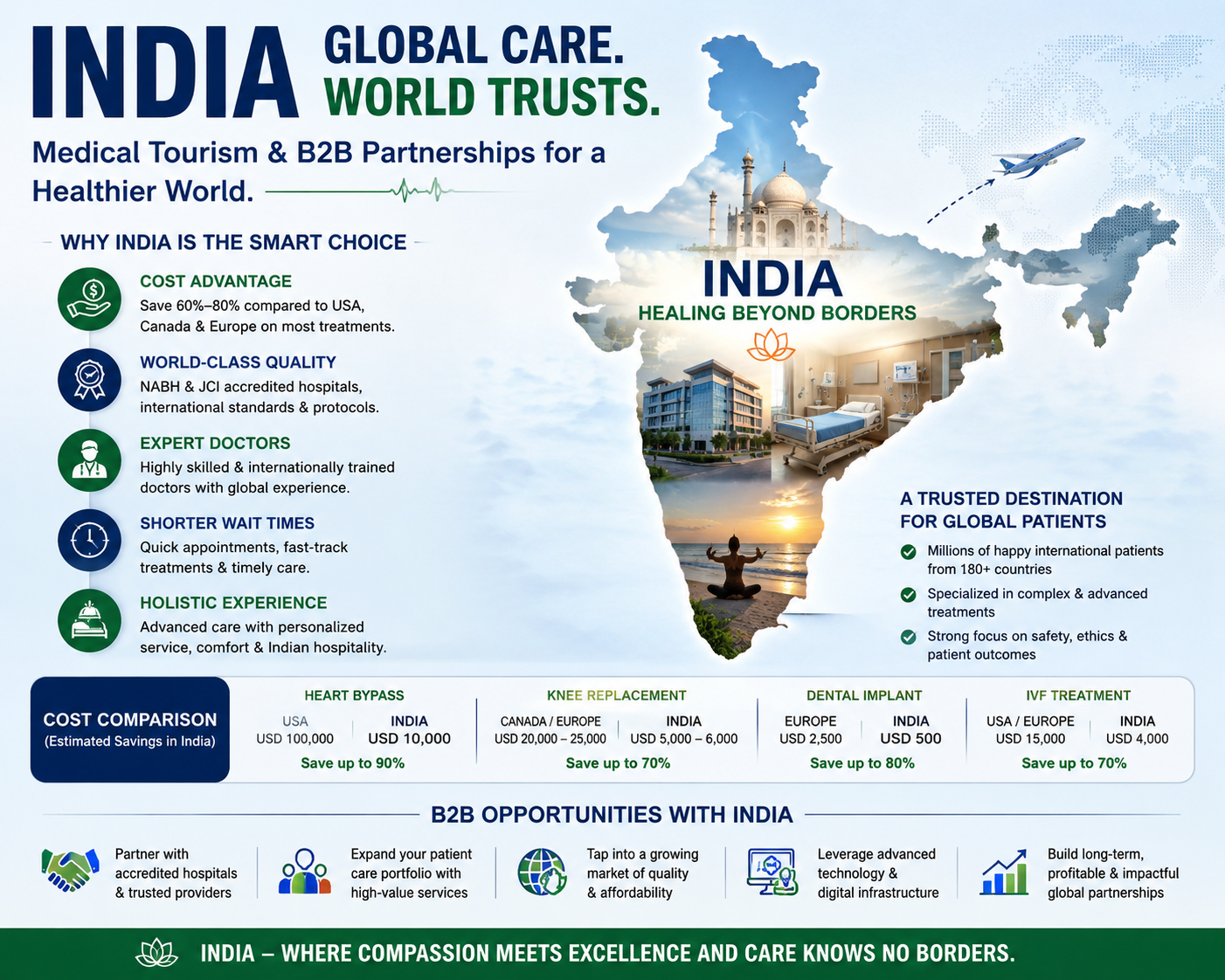
Yes, treatment in India can be dramatically less expensive than comparable private treatment in North America or Western Europe.
That matters enormously, particularly for:
- uninsured patients
- underinsured Americans
- self-pay patients
- elective procedures
- treatments with high deductibles
- procedures excluded from insurance
- patients seeking private alternatives to long public waiting lists
But cost alone does not explain India's growth.
India's real advantage is the combination of:
- experienced specialists
- sophisticated private hospitals
- high procedure volumes
- advanced technology
- English-speaking clinical teams
- significantly lower treatment costs
- relatively rapid scheduling
- dedicated international-patient departments
- rehabilitation and recovery services
- strong hospitality infrastructure
- traditional wellness options
India's Ministry of Health highlighted this combination in 2026, describing Medical Value Travel as being supported by skilled medical professionals, modern infrastructure, advanced specialty care, digital integration and internationally benchmarked standards.
That is a very different value proposition from inexpensive surgery.
India vs. the United States: When Excellent Healthcare Becomes Financially Difficult
There is no serious argument that the United States lacks world-class medicine.
It has some of the finest hospitals, research institutions and physicians in the world.
The problem is access to that excellence at a sustainable price.
For a well-insured patient receiving treatment within a strong health plan, remaining in the United States often makes complete sense.
But the picture changes dramatically for someone facing:
- large deductibles
- coinsurance
- uncovered procedures
- out-of-network specialists
- elective surgery
- dental reconstruction
- fertility treatment
- certain bariatric or cosmetic procedures
- extensive rehabilitation
In those situations, international treatment can become economically rational even after flights and accommodation are included.
India's opportunity
India gives American patients another option:
receive sophisticated care without inheriting the full cost structure of American healthcare.
The important word is value, not “cheap.”
A patient evaluating India should compare the complete episode of care:
consultation + diagnostics + physician fees + hospital costs + surgery + medication + rehabilitation + accommodation + travel.
That is far more meaningful than comparing one quoted surgery price.
India vs. Canada: The Value of Time
Canada's publicly funded healthcare system provides an enormous social benefit.
But universal coverage does not automatically mean immediate access to every elective procedure.
For a patient living with chronic pain, deteriorating mobility, or a condition requiring specialist intervention, waiting is not merely inconvenient.
Time can affect:
- quality of life
- ability to work
- mental wellbeing
- mobility
- family responsibilities
- disease progression
This is where medical tourism becomes relevant.
A Canadian patient who can clinically and financially travel may choose India not primarily to save money, but to buy back time.
Instead of waiting through multiple stages of referral, specialist assessment, diagnostics, and elective scheduling, private international treatment may compress the process significantly.
India's international-patient infrastructure is increasingly designed around precisely this kind of coordinated journey.
India vs. Europe: Private Care Without Western-European Private Pricing
Europe cannot be treated as one healthcare market.
Healthcare in the UK differs greatly from Germany, France, Spain, Italy, Scandinavia or Eastern Europe.
Many European countries provide excellent public healthcare.
The challenge can arise when patients want:
- faster access
- private rooms
- elective procedures
- specialist choice
- procedures outside public eligibility
- complex dental work
- fertility treatment
- cosmetic procedures
- second opinions
Private treatment solves some of those problems — but often at a substantial cost.
India introduces another option.
Instead of choosing between:
public system + wait
and
domestic private system + premium price
some patients can consider:
India + private specialist care + international-patient coordination.
The decision will not be right for every condition.
But for procedures that can be safely planned in advance, the value equation can become compelling.
India vs. South America: Scale and Specialty Depth
South America is already an important medical-tourism region.
Countries such as Brazil and Colombia have strong reputations in areas including cosmetic surgery, dentistry and private healthcare.
Geography also works in their favor for North American patients.
For Americans and Canadians, South America can mean:
- shorter flights
- smaller time-zone differences
- established cosmetic and dental tourism markets
India's advantage is different.
India offers extraordinary scale across specialties.
Rather than being associated primarily with a handful of treatment categories, India's medical-tourism ecosystem spans areas such as:
- cardiology
- cardiac surgery
- oncology
- orthopedics
- joint replacement
- neurology
- neurosurgery
- spine surgery
- ophthalmology
- urology
- gynecology
- fertility
- dentistry
- reconstructive surgery
- transplantation
- rehabilitation
That breadth matters particularly for complex cases involving multiple specialists.
India can function less like a procedure destination and more like a medical ecosystem.
The Specialist Advantage
One underappreciated strength of Indian healthcare is clinical volume.
India's population exceeds 1.4 billion.
Its major private hospital networks treat enormous numbers of patients.
In medicine, high volume can matter because specialists repeatedly encounter:
- common procedures
- unusual complications
- advanced disease
- complex multi-disciplinary cases
Many Indian physicians have also trained or worked internationally, including in the United States, United Kingdom, Canada, Australia and Europe.
For a medical tourist, physician selection should therefore focus not on nationality but on measurable experience:
- Where did the physician train?
- How many procedures of this type have they performed?
- What is their subspecialty?
- What are the hospital's outcomes?
- How are complications handled?
- What happens after the patient returns home?
Those questions matter more than glossy marketing.
India's Private Hospitals Are Built for International Patients
For someone who has never visited India, the phrase “hospital in India” can trigger outdated assumptions.
That gap between perception and reality is one of India's biggest marketing challenges.
Major private hospitals in cities such as:
- Delhi NCR
- Mumbai
- Chennai
- Hyderabad
- Bengaluru
- Kochi
can look and operate much like high-end tertiary hospitals anywhere else in the world.
Many offer technologies including:
- robotic-assisted surgery
- advanced radiation oncology
- PET/CT imaging
- sophisticated cardiac catheterization
- minimally invasive surgery
- transplant programs
- advanced intensive care
- precision diagnostics
India's official medical-tourism infrastructure also directs international patients toward information on accredited hospitals, healthcare providers, visas and wellness centers.
The key is choosing the right institution — not merely choosing India.
India Is Making the International Patient Journey Easier
Medical tourism involves more than medicine.
Think about everything a patient must manage:
- hospital selection
- physician selection
- medical records
- pricing
- visa
- flights
- airport arrival
- accommodation
- local transportation
- surgery
- caregiver arrangements
- medication
- rehabilitation
- return travel
- follow-up
That complexity can scare patients away.
India is actively trying to reduce that friction.
The government says e-Medical Visa and e-Medical Attendant Visa facilities have been extended broadly, while plans around the Medical Value Travel ecosystem include a revamped portal and concierge-style airport assistance.
That matters because the countries that eventually dominate medical tourism will not simply have excellent hospitals.
They will make the entire patient journey easy.
Where India Has an Advantage Nobody Else Quite Replicates
There is another dimension to Indian medical tourism that often gets treated as a footnote.
It should not.
India can combine conventional medicine with a substantial wellness ecosystem.
The Indian government has created dedicated Ayush visa categories for foreign nationals traveling for recognized traditional treatments and has introduced quality initiatives around wellness tourism.
This means a patient could theoretically structure a medically appropriate recovery journey involving:
- conventional surgery
- physiotherapy
- rehabilitation
- medically supervised yoga
- meditation
- nutrition
- Ayurveda-based wellness where clinically appropriate
- extended recovery in a lower-stress environment
This is not an argument for replacing evidence-based medicine with alternative treatment.
That would be irresponsible.
The opportunity is integration.
Modern medicine treats the disease or injury.
Recovery support can help restore the person.
India has cultural and institutional depth in both areas.
The Procedures Most Suited to Medical Tourism
Not every procedure should involve international travel.
Emergency medicine clearly does not.
Complex illnesses requiring constant continuity with a local team may not either.
Medical tourism is most compelling when treatment is:
planned, specialist-driven, relatively predictable, and capable of structured follow-up.
Common areas include:
Orthopedics
Hip replacement, knee replacement, spine procedures and sports-related orthopedic treatment.
Cardiac care
Bypass surgery, valve procedures and certain planned cardiac interventions.
Oncology
Second opinions, diagnostics and selected cancer treatments where travel is clinically appropriate.
Dental care
Implants, full-mouth reconstruction, crowns and complex restorative dentistry.
Fertility
IVF and related reproductive treatments, subject to legal and clinical eligibility.
Ophthalmology
Cataract procedures and selected eye surgeries.
Cosmetic and reconstructive procedures
Where clinical quality, accreditation and surgeon credentials are carefully verified.
Wellness and rehabilitation
Recovery programs, physiotherapy and medically appropriate wellness services.
But There Are Risks — and Patients Should Hear About Them
A serious medical-tourism article should not pretend the decision is risk-free.
It is not.
Potential challenges include:
- long-distance travel after surgery
- blood clot risk
- infection
- continuity-of-care problems
- differences in legal recourse
- difficulty managing complications after returning home
- inconsistent quality between facilities
- misunderstandings about pricing
- travel insurance exclusions
This is why patients should never choose treatment solely from an advertisement or a low quote.
Before traveling, they should have clarity around:
- Hospital accreditation
- Doctor credentials
- Procedure volume
- Complete pricing
- Complication management
- Post-operative stay
- Fitness-to-fly timeline
- Medical records transfer
- Follow-up with a physician at home
- Emergency contact after returning
A trustworthy medical-tourism organization should welcome those questions.
If it avoids them, walk away.
A Better Way to Compare the Markets
| Factor | India | USA | Canada | Europe | South America |
|---|---|---|---|---|---|
| Private treatment cost | Highly competitive | Very high | Moderate–high | Moderate–high | Competitive |
| Elective access | Often fast | Usually fast if affordable/insured | Can involve waits | Varies by country | Generally good privately |
| Specialist depth | Very strong | Exceptional | Strong | Exceptional | Strong, varies by destination |
| English communication | Widely available in major hospitals | Native | Native/strong | Varies | Spanish/Portuguese dominant |
| International-patient infrastructure | Extensive and growing | Limited need domestically | Limited need domestically | Strong at select hospitals | Strong in key destinations |
| Holistic wellness integration | Major differentiator | Limited | Limited | Growing | Varies |
| Scale across specialties | Exceptional | Exceptional | Strong | Exceptional | Varies |
The table reveals why India is interesting.
It does not necessarily “beat” every country on every dimension.
It combines enough strengths across all of them to create an unusually strong overall value proposition.
India's Medical Tourism Opportunity Is Bigger Than Hospitals
There is also a broader B2B opportunity here.
The medical-tourism ecosystem requires:
- hospitals
- international patient coordinators
- airlines
- hotels
- travel companies
- rehabilitation providers
- insurance companies
- telemedicine providers
- healthcare technology
- payment platforms
- medical records exchange
- language services
- concierge organizations
India itself describes the ecosystem as involving hospitals, facilitators, hotels, airlines, government bodies and other service providers.
This means medical tourism can become an international healthcare-services industry, not simply a hospital business.
That is where the next stage of growth could get very interesting.
Why India, and Why Now?
India has been treating international patients for years.
What is different now is the convergence of several trends:
Western healthcare costs continue to pressure patients.
Patients increasingly research healthcare globally.
Telemedicine makes pre- and post-treatment communication easier.
Indian private hospitals have become more sophisticated.
Government policy is actively supporting Medical Value Travel.
Digital platforms are making international coordination easier.
Wellness and preventive health are becoming part of mainstream consumer thinking.
And perhaps most importantly:
People are increasingly willing to question the assumption that the best treatment must necessarily be the treatment closest to home.
The Bottom Line
Medical tourism should never be about finding the cheapest surgery.
Healthcare is too important for that.
The decision should be about finding the best combination of clinical quality, specialist experience, timing, affordability, safety, and patient support.
That is where India has become increasingly competitive.
For an American facing an unaffordable treatment bill, India may provide financial relief.
For a Canadian facing a lengthy wait, it may provide faster access.
For a European considering expensive private treatment, it may provide better value.
For a South American patient requiring complex specialty care, it may provide broader clinical depth.
And for patients who want recovery to extend beyond the operating room, India's combination of advanced medicine, hospitality, rehabilitation and wellness offers something genuinely distinctive.
India's strongest medical-tourism proposition is therefore not:
“Come here because treatment is cheaper.”
It is:
“Come here because world-class healthcare can be more accessible, more coordinated, and more financially sensible.”
That is a far stronger message.
And it is why India deserves to be considered not merely as a medical-tourism destination, but as one of the emerging global centers of medical value travel.