Why businesses in the USA, Canada, South America, and Europe should look at India differently
For years, India was viewed mainly as an outsourcing destination, a place companies used for back-office work, support services, or low-cost development.
That view is now outdated.
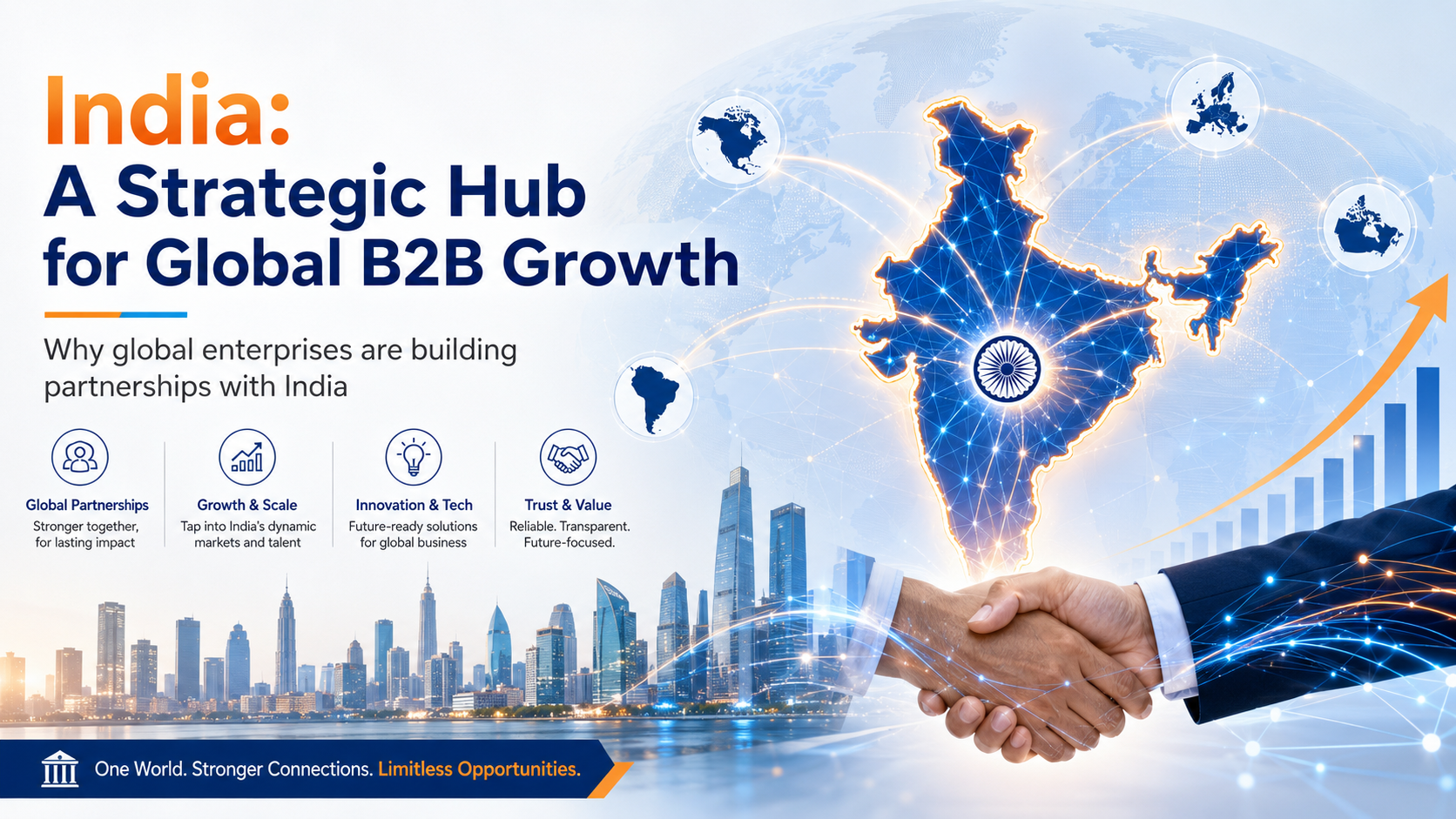
India is no longer just a cost-saving destination. It is increasingly a strategic B2B growth partner for global companies looking to scale faster, innovate smarter, and build long-term business capability. The shift is real: India’s export story is now heavily driven by services, and the World Bank notes that more than 40% of India’s exports are services, with business services as the country’s single largest export industry. On top of that, India now hosts about 1,700 Global Capability Centers (GCCs), showing how deeply multinational companies are embedding core business functions in India.
That matters.
Because the global B2B landscape has changed. Companies are no longer asking only, “How do we cut cost?” They are asking:
- How do we scale without exploding overhead?
- Where can we find skilled talent at speed?
- How do we stay competitive in AI, digital operations, data, and customer experience?
- How do we expand globally without building everything from scratch?
For a growing number of companies, the answer is: India.
India’s B2B appeal is bigger than price
Let’s be real: cost still matters.
But if your only lens on India is “cheap labor,” you’re already behind.
The smarter reason to consider India is this:
India offers a high-value mix of talent, scale, delivery maturity, digital capability, and business agility that is hard to match in one market.
India gives global businesses access to:
- large technical and professional talent pools
- English-speaking teams
- proven global delivery models
- strong digital adoption
- mature IT and business-services ecosystems
- 24/7 operating capability
- expanding startup and innovation culture
- a large domestic market that can also become a future customer base
That combination is what makes India powerful in B2B.
It’s not just about doing work for less.
It’s about building more for more impact.
Why India stands out for B2B partnerships
1. India gives businesses scale
Many countries offer talent. Fewer offer talent at scale.
If a company needs:
- 10 developers
- 20 analysts
- 50 support staff
- AI specialists
- finance operations teams
- healthcare processing teams
- quality assurance teams
- digital marketing support
- product engineering
India can support all of that — and often under one coordinated delivery model.
This is one of India’s biggest competitive advantages. Companies don’t just find workers here. They find operating capacity.
2. India has become a serious global capability hub
The rise of Global Capability Centers in India says a lot about where the market is going.
Multinational companies are not setting up GCCs in India just for low-level support anymore. They are using India for:
- engineering
- product development
- AI and automation
- cybersecurity
- analytics
- finance and shared services
- customer operations
- healthcare operations
- innovation and R&D
Roughly 1,700 GCCs are already operating in India, according to Invest India, which is a clear signal that India has become a serious strategic operations base for global enterprises.
That’s a big deal.
It means India is no longer just part of the support chain.
It’s increasingly part of the decision-making and value-creation chain.
3. India helps companies scale without U.S.-level labor costs
The United States remains one of the world’s strongest business markets. It leads in innovation, capital, product development, and enterprise spending.
But it also comes with high operating costs.
For example, the U.S. Bureau of Labor Statistics reports that the median annual wage for software developers was $133,080 in May 2024, with strong projected demand continuing through 2034. That tells you two things:
- The U.S. talent market is strong.
- It is expensive and highly competitive.
So for many U.S. companies, India is not a replacement for America. It is a strategic extension of America.
A common winning model is:
- leadership, sales, and customer relationships in the U.S.
- execution, engineering, analytics, and operational scale in India
That creates a more efficient global operating model.
India vs. USA: innovation meets execution
Why U.S. companies should consider India
The USA is unmatched in many areas:
- access to capital
- enterprise demand
- market size
- product innovation
- customer concentration
But it also faces:
- high wages
- talent shortages in specialized roles
- expensive scaling
- pressure on margins
- longer hiring cycles
India complements the U.S. by giving companies:
- cost-efficient scaling
- large technical talent pools
- 24/7 support models
- faster execution capacity
- strong back-end operations
The smartest play is not USA vs India.
It is USA + India.
That model lets businesses keep strategy and market presence close to the customer, while using India to build scalable execution power behind it.
India vs. Canada: scale advantage matters
Canada is a strong business environment. It offers stability, excellent institutions, strong research, and a high-trust business culture.
But from a B2B scaling perspective, Canada often presents challenges such as:
- higher labor costs in key metros
- smaller talent pools compared to India
- slower scaling for large operational teams
- narrower workforce depth in certain specialized delivery areas
Canada is strong in quality.
India is strong in quality plus scale.
That distinction matters a lot for businesses that need to grow fast, add teams quickly, or build round-the-clock delivery functions.
For Canadian businesses, India can become a highly effective partner for:
- software engineering
- finance and accounting support
- analytics
- healthcare administration
- operational support
- digital transformation
- customer service infrastructure
The result is a hybrid model: Canadian client-facing trust plus Indian delivery scale.
That’s a strong combo.
India vs. South America: time zone vs. ecosystem depth
South America has real strengths.
For North American companies, countries in South America often offer:
- closer time-zone alignment
- growing digital talent
- nearshore delivery convenience
- expanding tech ecosystems
The OECD has highlighted the region’s growing digital industries and the importance of digital transformation for future growth in Latin America and the Caribbean. So yes — South America is absolutely a rising B2B region.
But India still has a few major advantages:
- a much larger and more mature services ecosystem
- decades of global delivery experience
- deeper talent availability in several functions
- stronger scale for enterprise service models
- more established large-vendor and multi-industry infrastructure
If South America’s advantage is proximity, India’s advantage is depth and scale.
Many global businesses may eventually use both — South America for nearshore coordination and India for larger operational scale.
That’s where global strategy is headed.
India vs. Europe: flexibility and speed
Europe is packed with advanced markets, high engineering standards, and world-class enterprise sectors.
It is strong in:
- manufacturing
- industrial engineering
- finance
- pharmaceuticals
- enterprise software
- sustainability-driven innovation
At the same time, Europe is also a complex environment:
- higher operating costs in many countries
- fragmented markets
- multilingual requirements
- stricter regulatory environments
- slower scaling across borders
Eurostat reported that in 2025 the EU had 10.45 million ICT specialists, representing 5.0% of total employment, showing a substantial technology workforce. That’s strong — but businesses still face practical scaling and cost constraints across multiple countries and operating systems.
India’s edge against Europe is not that Europe lacks quality.
It’s that India often offers:
- faster scaling
- simpler centralized delivery
- lower operational overhead
- stronger price-to-capability ratio
- easier access to larger shared-service teams
For European firms, India can be a powerful execution partner that supports digital growth without forcing every function to be built domestically.
Key benefits of choosing India for B2B
Cost efficiency with capability
India still offers economic advantage, but now with far higher value delivery than the old outsourcing narrative suggests.
Access to broad talent pools
From engineering to healthcare admin to analytics to finance, India gives companies access to cross-functional capabilities.
English-speaking business environment
That lowers friction, speeds collaboration, and improves process alignment.
Proven delivery maturity
India has decades of experience serving global clients. That matters in process quality, reporting, governance, and service continuity.
24/7 operational leverage
India’s time-zone difference can actually be a superpower. Work can continue while North America or Europe sleeps.
Digital and tech ecosystem strength
India’s services-led export model and deep business-services base show that the country is structurally built to support B2B growth at scale.
Future market potential
India is not just a delivery destination. It is also a major future market. A business partnership in India today can become a market-entry opportunity tomorrow.
What companies should be careful about
Let’s not romanticize it.
India is a strong option, but not every vendor or partner is automatically the right one.
Businesses still need to do proper due diligence:
- check domain expertise
- verify security standards
- assess leadership maturity
- ask for client references
- review SLAs and reporting
- define ownership and accountability
- align on communication and time zones
- protect data and IP
India works best when it is approached as a strategic partnership, not a bargain-basement procurement exercise.
If you chase only the cheapest option, you may get exactly what you paid for.
Final thoughts
India has moved way beyond the old stereotype of being just a back-office outsourcing destination.
Today, India is increasingly a global B2B growth engine.
For companies in the USA, India offers a powerful way to scale execution without U.S.-level cost pressure.
For businesses in Canada, it offers scale and operational leverage.
For companies in South America, it offers a mature, high-capacity ecosystem.
For firms in Europe, it offers flexibility, speed, and strong value.
That’s the real pitch.
India is not simply where businesses go to cut costs.
India is where businesses can:
- build capability
- increase speed
- improve margins
- access talent
- support global operations
- create long-term strategic partnerships
If you are looking for a country that combines talent, scale, economics, and business maturity in one place, India deserves a serious look.
India is no longer just an outsourcing destination.
It is increasingly one of the smartest B2B partnership choices in the world.